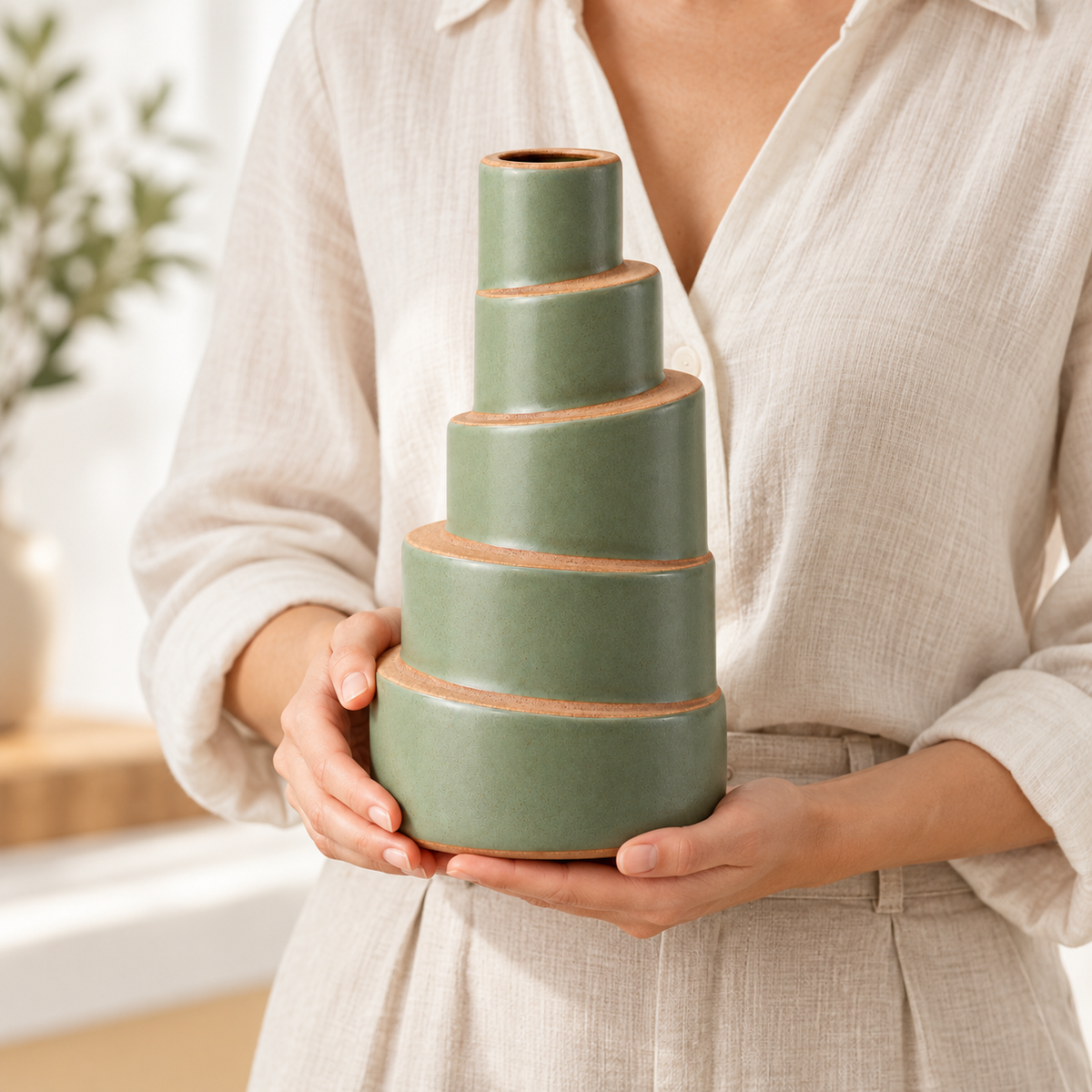
🌿 Stepped Ceramic Vase – Sage Green Tiered Stoneware, Natural Clay Edges, Soft Matte Glaze, Sculptural Silhouette for Modern Organic Home Decor
🌿 Stepped Ceramic Vase – Sage Green Tiered Stoneware, Natural Clay Edges, Soft Matte Glaze, Sculptural Silhouette for Modern Organic Home Decor
📢Try it now and if it doesn't work, we guarantee a full refund!
✅ Made in the USA
✅ 90-day money-back guarantee
✅ Natural ingredients for fast, long-lasting results
✅ Long-standing service to the London Early Years Foundation
⚡ Stock is limited and will sell out soon!
Couldn't load pickup availability
🌿 Stepped Ceramic Vase — Modern Sculptural Décor for Elevated Interiors: A Handcrafted Sage Green Five-Tier Stoneware Tower With Soft Sage Glaze, Exposed Natural Clay Rim Bands, Stable Wide Base, and a Tiered Silhouette of Minimalist Refinement That Functions as Both a Functional Vase and a Timeless Sculptural Statement in Every Room It Enters
Some objects are immediately understood the moment you see them. Their form is so resolved, their proportions so considered, their material so appropriate to their shape, that no explanation is required and no context is needed — they simply belong wherever they are placed. This is one of those objects. Five ceramic discs, ascending in precise sequence from a wide, grounded base to a narrow cylindrical neck, finished in a soft sage green glaze with exposed natural clay bands at every tier transition: a form that references temple architecture, growth rings, geological strata, and the patient accumulation of nature without literally depicting any of them. Minimalist Design · Timeless Style. At $52, this is the vase that changes the room it enters and stays relevant through every interior trend that follows.

🎯 Stepped Ceramic Vase — Modern Sculptural Décor for Elevated Interiors: A Full Account of the Four Core Attributes — Handcrafted Ceramic · Soft Sage Glaze · Tiered Silhouette · Decorative Accent — That Together Define This Object as a Category of One: the Architecturally Resolved Ceramic Tower That Is Equally at Home on a Kinfolk Coffee Table, a Marble Console, and a Japandi Nightstand Without Asking the Room to Change a Single Thing Around It
The hero banner presents the stepped tower in warm side-light on a travertine surface, the Kinfolk book stacked to its right, a trailing plant in a textured ceramic pot behind — the specific compositional language of an organic modern interior at its most considered. Four feature icons annotate the banner with the core attributes of the object. Here is the complete account of each:
- ✋ Handcrafted Ceramic — Why Choosing Handcrafted Stoneware Over Slip-Cast or Resin-Molded Alternatives Is the Material Decision That Determines Every Downstream Property of This Object: Its Weight, Its Surface Depth, Its Thermal Character, Its Tonal Variation in Different Lighting Conditions, and the Specific Quality of “Made by a Person, From the Earth” That No Production Process Can Fully Replicate at Any Price — Handcrafted ceramic is the origin material of this vase’s character. The five ascending discs are formed and finished by human hands rather than extruded or cast by machine, which means that the geometry of each tier — the precise width of each rim band, the specific radius of each disc edge, the exact height relationship between adjacent tiers — carries the calibrated intention of a maker rather than the algorithmic output of a mold. At the scale of close inspection, this difference is legible: the surface of handcrafted stoneware has a depth and tonal variation that slip-cast ceramics and resin alternatives do not, the result of clay that has been worked, dried, glazed, and fired in a process that introduces and then resolves the small variations that make the surface interesting to look at over time. A resin-molded vase is the same on day one as it is on day one thousand. A handcrafted ceramic deepens with attention.
- 🍃 Soft Sage Glaze — The Specific Colorway That Makes This Vase the Most Universally Compatible Decorative Ceramic Available at This Price for Warm, Organic, Natural-Toned Interiors: A Grey-Inflected Green That Reads as Botanical in Morning Light, as Architectural in Overcast Light, and as Warm and Amber-Touched in Evening Lamplight — and Why the Soft Sage Glaze Is the Color Decision That Gives This Vase Its Longest Possible Useful Life in Any Interior It Enters — Soft sage is the specific point in the green spectrum where green loses its insistence. It is not the bright, saturated green of a statement piece that announces itself and then tires; it is the muted, grey-inflected sage of eucalyptus leaves, of lichen on limestone, of aged artichoke — the color that reads as a natural presence rather than a chromatic choice. In a warm interior with linen cushions and warm wood furniture, soft sage reads as botanical: the color of something grown rather than manufactured. In a cooler, more minimal interior with white walls and concrete surfaces, it reads as architectural: a resolved, grey-green tone that provides warmth without insistence. This dual register — botanical and architectural simultaneously — is the property that makes this colorway compatible with every interior palette that includes natural, warm, or organic tones, which is to say: the vast majority of the interiors that would welcome this object.
- 🏗️ Tiered Silhouette — What the Five-Disc Ascending Tower Form Achieves That No Conventional Vase Silhouette Can: A Three-Dimensional Profile That Changes Meaningfully From Every Viewing Angle, That Creates Its Own Internal Visual Rhythm Through the Regular Alternation of Sage-Glazed Disc Faces and Exposed Clay Rim Bands, and That Provides a Vertical Presence on Any Horizontal Surface Without the Visual Weight of a Solid Mass Form of Equal Height — The tiered silhouette is the formal innovation that separates this vase from the category of “decorative ceramic” and places it in the adjacent category of “architectural object that also holds flowers.” The five ascending discs create a profile of graduated scale — wide and stable at the base, narrow and focused at the top — that reads as a tower from across the room and as a stack of carefully proportioned forms at close range. The internal rhythm of the form — sage disc face, terracotta rim band, sage disc face, terracotta rim band — repeating four times from base to neck — creates a visual cadence that makes the full height of the tower interesting to follow from bottom to top, like a melody that resolves in the narrow neck at the summit. This vertical rhythm is the property that makes this vase read as more than its material: it is not merely a ceramic object, it is a ceramic object with a score.
- 🌸 Decorative Accent — The Specific Role This Vase Plays in a Composed Interior: Not the Background Object That Supports Other Elements, Not the Statement Piece That Demands Subordination From Everything Around It, but the Precise Middle Register of “Decorative Accent” That Is Visually Significant Without Being Visually Demanding, That Enriches the Composition of Every Surface It Occupies Without Requiring That Surface to Reorganize Itself Around the New Arrival — A decorative accent, as a category of interior object, is the specific type of piece that adds visual interest to a composed surface without disrupting the composition already established there. This vase operates in that register with particular precision. Its sage green tone is warm enough to relate to the natural materials of an organic interior — the linen, the wood, the woven rattan — without demanding that those materials acknowledge it. Its tiered silhouette is architecturally resolved enough to provide genuine visual interest without requiring the surrounding objects to defer to it. It is the object that makes a surface better without making that surface about itself — the specific quality of a decorative accent that has been designed rather than merely decorated.

✨ Versatile Styling for Every Space — A Sculptural Accent That Complements Modern Interiors: Four Domestic Settings — Living Room · Dining Table · Entryway · Bedside — Photographed in Warm Natural Light With Four Distinct Arrangement Types, Together Demonstrating That the Stepped Sage Tower Belongs in Every Room of a Modern Home as a Compositional Anchor, a Sculptural Focal Point, and a Quiet Daily Pleasure
The versatility banner presents four panels in a horizontal sequence, each labeled with the domestic context it depicts: Living Room, Dining Table, Entryway, Bedside. Together they constitute a complete argument for this vase across the full spatial range of the modern home — from the most public and compositionally formal (the living room) to the most private and intimate (the bedside). Here is the detailed account of each:
- 🛋️ Living Room — The Leftmost Panel, Where the Stepped Sage Tower Sits on a Warm Stone or Travertine Surface Before a Framed Art Print in a Warm Wood Frame, Beside a Stack of Kinfolk Books, Holding a Loose Arrangement of Olive Branches and Fine-Stemmed Leaves in the Bright Raking Light of a South-Facing Room, Where the Five-Tier Silhouette Reads Against the Warm Interior as the Botanical-Toned Vertical Anchor of a Shelf or Console Composition That Has Been Assembled With Genuine Attention to the Relationship Between Objects, Surfaces, and Light — The living room panel establishes the most architecturally ambitious context for this vase: the curated shelf or console composition that serves as the visual focus of a seating area. In this panel, the stepped tower rises beside a stack of Kinfolk books — the specific cultural object that signals organic modern taste — and before a warm-framed art print, with trailing olive branches emerging from the narrow neck opening and extending horizontally to the right. The olive branch arrangement is the specific botanical type that most naturally complements this vase’s sage green glaze: the grey-green of olive leaves and the muted sage of the glaze are in the same chromatic family, creating a color harmony between the vessel and its arrangement that reads as considered and unified rather than arbitrary. The Kinfolk book stack to the right — a low horizontal element that grounds the composition on the surface — and the framed print behind — a vertical element that gives the arrangement its backdrop — constitute the specific still-life composition in which this vase most fully realizes its role as a decorative accent.
- 🍽️ Dining Table — The Second Panel, Where the Stepped Sage Tower Sits at the Center of a White Marble or Stone Dining Table Set for an Informal Gathering, Holding a Mixed Arrangement of White Wildflowers, Eucalyptus Rounds, and Fine-Stemmed Botanicals That Rise From the Narrow Neck Opening at a Height That Allows Full Sightlines Across the Table, Beside a Water Glass and a Small Ceramic Trinket Bowl, in the Even Natural Light of a Well-Positioned Dining Room, Where the Tiered Tower Functions as the Table’s Compositional Center Without the Visual Obstruction of a Wide or Tall Traditional Centerpiece Arrangement — The dining table panel demonstrates the most practically significant property of this vase’s narrow neck opening: it concentrates stems into a compact bundle that spreads outward at the top rather than filling the opening with a wide base of compressed stems, which means that even a generous mixed arrangement — white wildflowers, eucalyptus, fine botanicals — rises from the vase at a column width narrow enough to maintain full sightlines across the table for everyone seated. A wide-opening vase at a dining table creates a visual barrier; the narrow-neck stepped tower creates a vertical focal point that draws the eye upward without blocking the horizontal plane of the table setting. Guests on opposite sides of the table see each other over the arrangement rather than through it, which is the specific property that makes this vase the most considerate centerpiece choice at a dining table that is actually used for dining rather than merely photographed.
- 🚪 Entryway — The Third Panel, Where the Stepped Sage Tower Stands on an Entryway Console or Side Table Before a Round Gold-Framed Mirror That Reflects the Room and Doubles the Visual Presence of the Tiered Tower, Without Any Floral Arrangement, Its Five-Tier Silhouette Reading Against the Warm Cream Wall and the Round Mirror as a Sculptural Vertical Element Whose Form Is Sufficient to Organize the Entire Entryway Composition Around It Without the Addition of Any Flowers or Supplementary Objects — The entryway panel is the most formally instructive of the four: it shows the stepped tower without any arrangement, its pure silhouette visible against the warm wall in the round mirror behind it. The round mirror — a gold-framed circle that reflects the tower and the room simultaneously — creates the specific “mirror echo” composition that interior stylists use to make an entryway feel larger, more considered, and more composed: the object reflected in the mirror appears twice in the visual field, once in front of the mirror and once within it. The stepped tower, reflected in the gold-framed mirror, becomes a doubled architectural element — its tiered silhouette visible in front of and within the reflective surface simultaneously, creating a depth and visual complexity in the entryway that a single non-reflective surface cannot produce. This is the panel that most directly demonstrates the vase’s claim to “sculptural” status: it needs no flowers in the entryway because the form is the decoration.
- 🌙 Bedside — The Rightmost Panel, the Most Intimate of the Four Contexts, Where the Stepped Sage Tower Sits on a Warm Wood Nightstand Beside a Softly Glowing Ceramic Table Lamp, Holding Two or Three Eucalyptus Sprigs in Its Narrow Neck Opening in the Warm Amber Light of a Bedside Lamp at Evening, the Five-Tier Form Reading at Close Intimate Range as the Object Whose Considered Form and Quiet Sage Color Make It the Last Beautiful Thing Seen Before Sleep and the First Noticed Upon Waking — The bedside panel shifts the register of the vase from public to private, from composed to intimate. At the scale of a nightstand, in the warm amber light of a bedside lamp, the stepped tower reads differently than it does in the living room or entryway: closer, more personal, more consistently present. The two or three eucalyptus sprigs in the narrow neck — minimal, restrained, deliberately sparse — demonstrate the specific composition that the narrow-neck tower makes possible with the fewest stems: a single direction of growth from the concentrated opening, extending upward and slightly to one side, the simplest possible arrangement that still reads as intentional. In the bedside context, this minimalism is the correct register: the bedroom does not require the abundance of a living room arrangement or the considered vignette of an entryway composition. It requires a quiet presence — something beautiful, restrained, and consistent. This vase, at this scale, in this light, with three eucalyptus sprigs, is exactly that.

🔬 Material & Design Details — Crafted to Bring Texture, Balance, and Artistic Form Into Your Home: Four Annotated Design Properties — Smooth Ceramic Finish · Natural Clay Edge · Stable Wide Base · Sculptural Tiered Form — Examined at the Close-Range Scale Where Material Quality, Structural Balance, and Formal Precision Become Fully Legible as the Specific Craft Decisions That Separate This Object From Every Mass-Produced Stepped Ceramic Alternative
The material and design banner presents four annotated detail images connected to the full-body center photograph, each revealing a specific property of the vase at the scale where that property becomes most legible. Here is the complete account of each:
- ✨ Smooth Ceramic Finish — “A Soft, Matte-Sheen Glaze With a Refined, Tactile Ceramic Texture”: What the Upper-Left Close-Up Reveals About the Specific Surface Quality of the Sage Green Glaze at the Scale Where Its Matte-to-Satin Finish Character, Its Slight Luminosity Under Raking Light, Its Continuous and Even Application Across the Full Face of Each Disc, and Its Specific Tactile Quality Under the Fingertip Are Fully Legible as Properties of a Premium Fired Stoneware Glaze Rather Than a Painted or Printed Surface Treatment — The smooth ceramic finish of this vase is a matte-sheen glaze — neither a true flat matte nor a high-gloss surface, but the intermediate quality that catches light at raking angles while remaining non-reflective at direct viewing angles. At close range, the matte-sheen quality of the sage glaze is legible as a surface that has depth: it does not sit on top of the clay body as a separate layer but integrates with the ceramic surface in the way of a fired glaze that has fused with the clay chemistry during kiln firing. Run a fingertip across the surface of this vase and what you feel is the specific combination of smoothness and slight resistance that distinguishes a quality fired glaze from a smooth-to-the-touch but visually flat industrial surface treatment. This is the tactile quality that confirms the claim “handcrafted ceramic” at the scale of direct experience rather than visual description.
- 🌾 Natural Clay Edge — “Exposed Natural Clay Bands Add Warmth, Contrast, and Artisanal Character”: What the Upper-Right Close-Up Reveals About the Specific Width, Surface Texture, Color, and Visual Role of the Unglazed Terracotta Rim Bands That Circle the Full Circumference of Each Tier Transition, and Why These Four Exposed Clay Bands Are the Single Design Detail That Most Directly Communicates the Handcrafted, Artisanal Character of This Object to Anyone Who Encounters It at Close Range — The natural clay edge bands — the unglazed terracotta visible at the horizontal rim of each disc before the next disc begins — are the most formally distinctive detail of this vase and the detail that most directly communicates its handcrafted origin. In the upper-right close-up, the terracotta band is visible at the scale where its specific properties are fully legible: the width of the band — generous, not token; the surface texture — slightly porous and warm compared to the adjacent glazed surfaces, the texture of fired earth that has not been sealed or smoothed; the color — a warm, amber-tinged terracotta that reads against the cool sage green of the glaze faces as a warm counterpoint, the relationship between earth and plant rendered in ceramic. These bands serve three simultaneous purposes: they mark the construction logic of the five-disc form, making each tier transition visible as a design decision; they introduce a warm natural tone that keeps the cool sage green of the glaze from reading as cold; and they create the horizontal rhythm — four bands at four transitions — that gives the tiered tower its visual cadence from base to neck.
- 🛡️ Stable Wide Base — “A Solid, Rounded Base Provides Excellent Stability and a Grounded Presence”: What the Lower-Left Close-Up of the Base Disc Reveals About the Specific Diameter-to-Height Proportion of the Widest Disc, the Rounded Profile of Its Curved Face, the Unglazed Terracotta Bottom Contact Surface, and the Engineering Logic That Allows a Five-Tier Ceramic Tower to Stand Without Ballast, Adhesive, or Widened Artificial Base — and Why the Wide, Low-Profile Base Disc Is the Structural Decision That Makes Every Other Formal Decision of This Vase Possible — The stable wide base disc is the foundation that makes the tower form viable as a real object rather than a rendered concept. In the lower-left close-up, the base disc is visible in its full proportion: substantially wider in diameter than the disc above it, lower in profile height relative to its diameter than any of the upper tiers, its curved face sweeping from the contact surface at the bottom to the terracotta rim band at the top in a continuous, rounded profile that reads as grounded rather than precarious. The unglazed terracotta bottom of the base disc — the contact surface between the vase and whatever surface it sits on — provides the specific non-slip friction of an unfinished clay surface on wood, marble, stone, or travertine: the same physical property that makes pottery wheels grip their bats and that makes unglazed ceramic bases more stable on smooth surfaces than their glazed-bottom counterparts. Wide, low, rounded, unglazed at the contact surface: this is the base engineering that keeps a tall, top-narrowing tower stable across the full range of surfaces on which it will actually be placed in actual homes.
- 🏛️ Sculptural Tiered Form — “A Modern, Stacked Silhouette That Brings Artistic Form and Visual Interest to Any Space”: What the Lower-Right Close-Up of the Full Tower From a Low Angle Reveals About the Complete Visual Experience of the Five-Tier Ascending Structure When Seen at Eye Level From Below, How the Perspective Distortion of the Low-Angle View Emphasizes the Tower’s Vertical Presence and the Receding Scale of Each Successive Disc, and Why the Sculptural Tiered Form Is the Formal Achievement That Earns This Object Its Description as “artistic” Rather Than Merely “decorative” — The lower-right close-up presents the full five-tier tower from a low, close angle that emphasizes its architectural verticality: the base disc filling the foreground of the image, the successive tiers receding upward and inward in perspective, the narrow neck at the summit framed by the open space above it. From this angle, the proportional logic of the stacked-disc form is most fully legible: each successive disc is smaller in diameter but taller in relative profile, which means that as the tower rises, each tier appears to accelerate upward — the visual equivalent of a diminuendo in music, a form that grows quieter and more refined as it rises toward its resolution in the narrow neck at the top. This is the formal property that earns the description “sculptural”: the tower does not merely hold flowers and occupy space, it creates a visual experience of ascent, of progression, of a form moving with purpose from its broad, grounded base to its narrow, focused summit.
🎁 The Object That Arrives and Never Leaves — Why the Stepped Sage Ceramic Tower Is the Home Gift That Communicates Genuine Taste, Why Its Combination of Minimalist Design and Timeless Botanical Color Makes It the Right Object for Every Interior Register, and Why at $52 It Delivers a Level of Formal Resolution That Its Price Makes Seem Implausible Until the Moment It Is in the Room
The people who are most worth buying for — the ones with homes that have been carefully composed over time, with specific tastes and developed aesthetic standards — are the hardest to find objects for. Not because they are difficult, but because they have already made the obvious choices. The canonical gifts of the organic modern home — the linen throw, the beeswax candle, the simple ceramic bowl — are already there, already integrated, already performing their role in a home that does not need more of what it already has.
What it does not yet have — in most cases — is a five-tier stepped sage green ceramic tower with exposed natural clay rim bands, because this specific object requires a degree of aesthetic attention to find that most gift-givers do not invest. When it arrives, that attention is communicated immediately and completely. For a housewarming, it is the first architecturally resolved decorative object in a new home. For a birthday, it is the piece that remains on the console through every season, holding dried pampas in winter, tulips in spring, eucalyptus in summer, and the memory of a gift that was genuinely considered in every single arrangement. At $52, it costs what thoughtfulness is worth and lasts considerably longer.
📋 Product Specifications
- Material: Handcrafted stoneware ceramic — soft sage matte-sheen glaze with exposed natural clay rim bands
- Form: Five ascending disc tiers — stable wide rounded base tapering to narrow cylindrical neck opening
- Surface: Smooth matte-sheen sage green glaze (disc faces) · Exposed natural terracotta (rim bands and base contact)
- Opening: Narrow cylindrical neck — concentrates stems for refined compositions with 2–6 stems
- Style: Minimalist Design · Timeless Style · Modern Sculptural Décor
- Best For: Olive branches, eucalyptus, tulips, white wildflowers, ranunculus, dried pampas, cotton stems, single botanical stems
- Style Compatibility: Organic Modern · Japandi · Wabi-Sabi · Artisan Boho · Kinfolk Aesthetic · Scandinavian Earth-Tone · Transitional Warm
- Ideal Placement: Living room shelf or console · Dining table center · Entryway console · Bedside nightstand · Bookshelf focal point · Kitchen island
- SKU: USD-HP-019
📦 Packaging & Delivery
- Individually wrapped in protective tissue and shipped in a double-walled carton engineered for the tiered tower form
- Gift-ready presentation — optional handwritten message card available at checkout
- Ships within 2–4 business days with full tracking
- 180-Day Satisfaction Guarantee — Arrives damaged? Immediate replacement. Not completely satisfied within 180 days? Full refund, no questions asked.
⭐ From Owners Who Have Placed This Vase and Never Moved It
“I bought it for the living room bookshelf and it immediately became the object that every guest asks about first. Empty it’s architecture. With dried olive branches it’s the most considered shelf composition I’ve ever had. The clay bands against the sage glaze are something photographs genuinely cannot capture — you have to see it in the light of your own room to understand what it does.”
— Elise T., verified buyer
“The narrow neck is the feature I didn’t know I needed in a vase. Two tulips and a eucalyptus sprig and it looks like a composition that took thought. Three stems, done. That’s the design working for you instead of requiring you to work for it.”
— Julian R., verified buyer
“Gift for my best friend who has a perfectly composed Japandi home and extremely exacting taste. She placed it on the entryway console beside the round mirror on the day it arrived and has not moved it since. She said it was the first gift she had ever received that felt as though it had been made for her specific home. That is the review. That is everything.”
— Camille D., verified buyer
◈ SKU: USD-HP-019 | $52.00 | Free Shipping Over $50 | 180-Day Money-Back Guarantee | Secure Checkout ◈
🌿 Soft sage glaze. Exposed natural clay bands. Five ascending tiers. One narrow neck for endlessly refined arrangements. Minimalist design. Timeless style. Shop with complete confidence — 180 days to love it or your money back.

🌿 Stepped Ceramic Vase – Sage Green Tiered Stoneware, Natural Clay Edges, Soft Matte Glaze, Sculptural Silhouette for Modern Organic Home Decor